2026.10.18 · Kintsugi Journal
Shallow Breathing and a Tight Back in Fukuoka's November Cold? How to Loosen the Whole Back Line Near Hakata Station
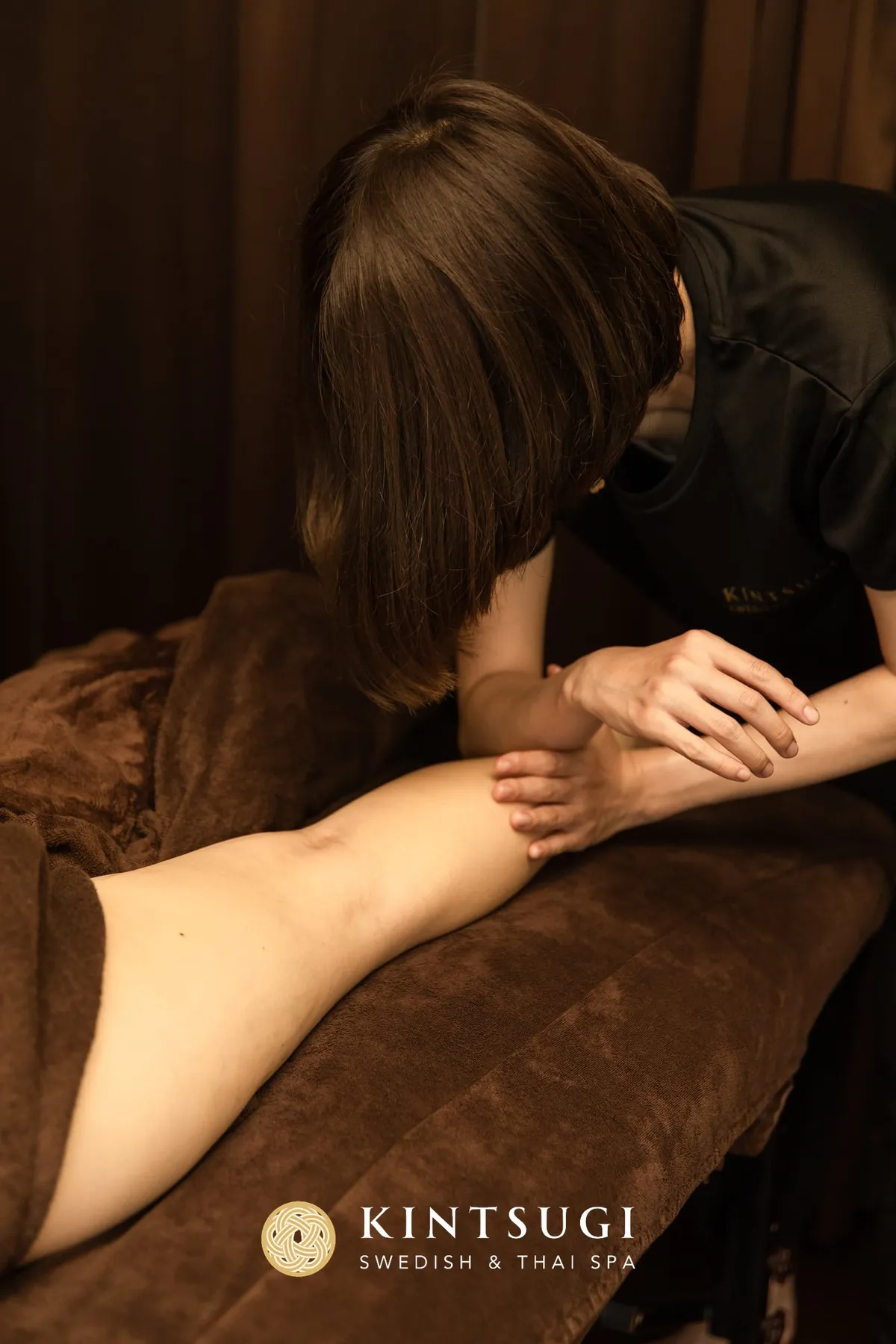
When the air turns colder in Fukuoka, most people notice their shoulders first. But there is another change that sneaks up on you quietly: your breathing gets shallower. You take smaller breaths, your back feels tight across the shoulder blades, and by evening you feel strangely tired even if you did not do much. If that sounds familiar, you are not imagining it. The cold has a lot to do with it.
Why does cold weather make your breathing feel shallow?
Because the cold makes you curl inward without realizing it. When the temperature drops, your body naturally pulls your shoulders up and forward and tucks your chest down to stay warm. Hold that posture for hours, through a day of sightseeing or a long stretch at a desk, and the muscles along your upper back, between your shoulder blades, and around your ribs start to stiffen. Those muscles are the ones that let your rib cage expand when you breathe in. When they are tight, your breaths get smaller and quicker, and you end up using only the top of your lungs.
Many guests describe it as feeling like they cannot get a full, satisfying breath. It is less about the lungs themselves and more about the back and ribs that surround them refusing to open up.
Why does a tight back leave you feeling so tired?
Because shallow breathing and tired muscles feed into each other. Smaller breaths mean your body is working a little harder all day to get the air it needs, and that low-level effort adds up. On top of that, the muscles across your back stay contracted for long periods, which is its own kind of fatigue. You go to bed tired, wake up still a bit stiff, and start the next day one step behind.
For travelers, this stacks on top of everything else. A long-haul flight keeps you folded into one position for hours. Then you spend your days walking around Fukuoka, carrying bags through Canal City, and sleeping on an unfamiliar pillow. The back line of your body rarely gets a chance to fully release.
What actually helps loosen the back and open up your breathing?
Releasing the muscles along the whole back line, from the base of your neck down through the shoulder blades and around the ribs. This is where slow, warm, full-contact Swedish massage does its best work. Rather than poking at one sore spot, the pressure moves along the length of the back to ease the muscles that have been bracing against the cold. As those muscles let go, the rib cage can move more freely again, and a lot of guests notice their breathing feels deeper and easier almost on its own.
At Kintsugi Spa, our therapists trained in Canada and focus on this kind of steady, whole-back approach. You do not need to explain the anatomy. Just mention that your back feels tight and your breathing feels shallow, and they will work through the areas that tend to lock up in colder weather.
Can you fit this in during a short trip or a busy week?
Yes, and that is part of the point. Kintsugi Spa is a 7-minute walk from Hakata Station and near Canal City, so it is easy to drop in between sightseeing stops, after a day of meetings, or before heading back to your hotel. If you have been flying, walking all day, or hunched over a laptop, an hour here can reset a lot.
Our staff speak English, so you can relax and describe how your body feels without worrying about translation. Plenty of our guests are visitors and expats dealing with exactly this mix of cold-weather stiffness and travel fatigue, so you are in familiar company.
If your back has been tight and your breaths have felt small lately, give it a chance to open back up. Book online whenever it suits you, and come let your back settle before Fukuoka's winter sets in.